
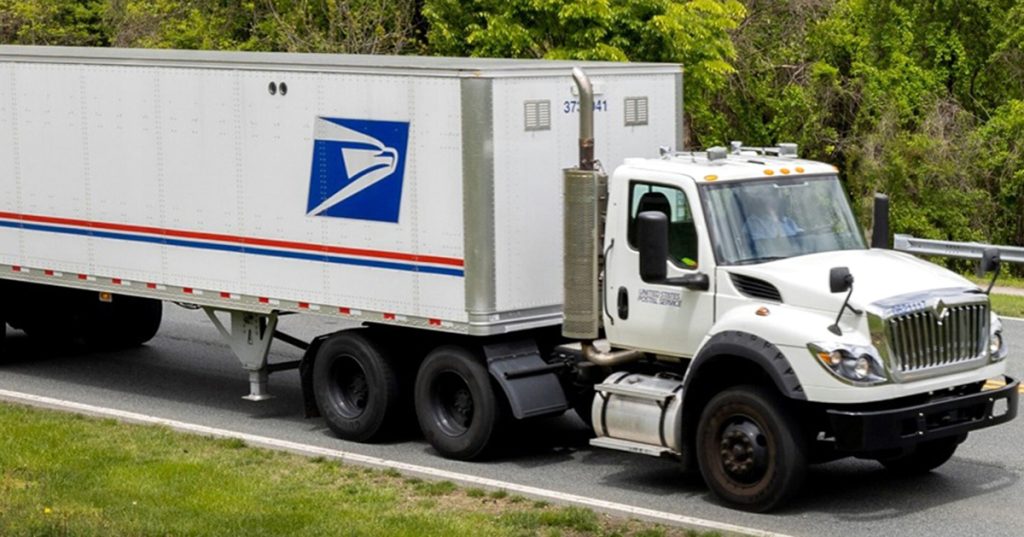
The first unit of Government owned motor vehicles was established in Washington, D.C. during October, 1914 and as late as August, 1916 was operating in only eight cities – these cities having 276 trucks and 817 employees.
Prior to October, 1914, all vehicular service in cities was on the contract basis. However, by September, 1927 seventy-five percent (75%) of the vehicular service was performed with Government owned trucks and only twenty-five (25%) with trucks secured under contract.
On July 2, 1927 the Government owned Motor Vehicle Service had grown until it embraced 589 cities, 5,809 trucks, 3,814 regular and 543 substitutes or a total of 4,357 employees. An additional 600 trucks were added in that same year.
Also in 1927 there were thirty (30) strategically located, well equipped central repair plants, where trucks were rebuilt in excess of 400 per month.
During the fiscal year ending June 30, 1927 Government owned trucks rendered 15,500,000 hours of service, which is equivalent to that service which one truck would be able to render if it was operated continuously for 1,781 years.
The cost of all vehicular service in cities during the fiscal year ended June 30, 1927 amounted to $27,387,378.00 of which the sum of 12,900,648.00 was on account of the Government owned service and $4,186,630.00 on account of the operation of contract vehicular service.
It is also interesting to note at this same point in time of the year 1927, there was no night differential and drivers were receiving a mere .82 cents per hour. The Postal Service was discouraging any increase in salary as they felt what was gained in using Government owned vehicles in lieu of contract service would be lost this way. Consequently, when it was proposed at the Second National Convention of the National Post Office Motor Vehicle Employees in Kansas City, Missouri on Sept. 6th, 1927 (Resolution NO. 27, Local 49, Buffalo, NY) that the National President be placed on a salary basis and be sent to Washington, D.C. during Congressional Sessions, the resolution committee at that convention disapproved and their decision was upheld by the delegates, unanimously.
“Hi Brother, how about kicking in a few bucks toward sending someone down to Washington to represent us at the salary hearing?” This was the common approach by a number of fellows around the garage in Chicago, Illinoi in 1924. Our Organization was then in its infancy. We were known as the National Association of Post Office Chauffeurs and Mechanics Union, and had only a handful of members. We didn’t have enough money then in our treasury to send a man across the street, let alone to Washington, D.C.
Getting the necessary funds together to enable us to have some sort of representation wasn’t too hard, but a great number of the members would only contribute when it was agreed that their names would in no way be used. Back in those days Postal employee organizations did not occupy a favorable Post Office Department that they enjoy today.
As a matter of fact, a former General Superintendent, whenever he had occasion to address the Motor Vehicle employees, would warn them that should they organize and become successful in obtaining any further benefits or salary increases, there was every possibility of the Service being put out to private contractors and all would lose their jobs. As a constant reminder, he had posted in the several garages a huge sign reading – “CONTRACT SERVICE?”
However, a sum of money sufficient to send three men – John P. Begley, Joseph Guzolek & Charles Andres – to Washington to represent us was raised. There can be no question as to the good intentions of these gentlemen, but due to their lack of experience in matters of this nature, the trip did not bear much fruit. The salary reclassification bill when finally enacted into law dropped most of the Motor Vehicle employees $100.00 below the Clerks and the Carriers.
There was no doubt, now, that unless the Motor Vehicle Service employees joined together in one strong national organization and made provisions to have a fully qualified representative to present their side of the story they would soon be left far behind the other Postal groups. Thus began the formation of the National Federation of Post Office Motor Vehicle Employees, by a small group of men who can honestly be called the “pioneers” of our organization.
For a number of years our membership was so small that we could only send our representative to Washington when matters of prime importance were about to come up and then, they could only stay a few days. This was, at best a most unsatisfactory arrangement, because it was impossible for our representative to make and maintain the personal contacts that are so necessary for success in this type of work. In spite of this drawback, we did manage somehow to stay abreast of the times and began to receive all the benefits that other Postal groups received.
At the Eighth Biennial Convention held in Louisville, Kentucky in 1939, it was decided we had grown sufficiently to keep a representative in Washington during the sessions of Congress. In the early part of 1941 an office was established as National Headquarters and at the Ninth Biennial Convention in September, 1941, at Indianapolis, Indiana, our membership was large enough to warrant the authorization of a full time representative.
Soon we were proudly operating from a five room suite of offices at 412 Fifth Street, N.W., Washington, D.C. It was modern in every way and was manned by two well informed and fully qualified, year-round National Officers who were on leave of absence from the Post Office Dept. to handle our organization’s affairs. Best of all, we had NATIONAL EXCLUSIVE RECOGNITION for the Motor Vehicle Craft – both Maintenance and Operations and, therefore, were the SOLE representative for the Motor Vehicle Craft and recognized as such by government officials and members of Congress.
During the time Congress was in session, frequent bulletins were sent to each local so the membership was kept fully informed of exactly what took place in Washington. The official organ of the Federation was the “ROTOR”. It was published monthly and devoted itself to matters of interest and importance of the Motor Vehicle employees and was sent directly to each member’s home every month. The cost of the subscription was included in the amount paid each month as dues.
A considerable number of employee organizations, supposedly founded for the benefit of the employees, came and went during the history of the Motor Vehicle Service. We took a great deal of pride in being able to truthfully state that all through the years, ours was the only organization that had functioned solely in behalf of the Motor Vehicle Service employees. Ours was the ONLY organization recognized by Congress and the Post Office Department as the SOLE representative of the Motor Vehicle Craft as a National Exclusive Organization.
Our Federation differed from so-called “Postal Employee Organizations in that every National and Local officer was a Motor Vehicle employee. All of our National Officers had many years of service in the M.V.S. – from both Maintenance and Operation – and were fully qualified to serve the membership. This statement holds true today.
Mr. Paul M. Castiglioni was the first resident, National President and hailed from the Chicago, Illinois area. He served until 1958. His successor was Everett G. Gibson of New York who was followed by Chester W. Parrish of Miami, Florida in 1968. Brother Parrish saw us through the successful merger of the National Federation of Post Office Motor Vehicle Employees, AFL-CIO with three other Exclusively recognized crafts, namely; Clerks, Special Delivery Messenger and the Maintenance Craft. Also, into the merger came the National Postal Union to form the now American Postal Workers Union. AFL-CIO.
Last, but not least, we have fifteen part-time field officers.
Among the many functions of this Union as it exists today, are:
- Publishing important issues in the News Service Bulletin as they occur.
- Writing an informative article of interest in the American Postal Worker (our monthly publication)
- Meeting with Postal Officials on current and recurrent issues of importance to locals, such as contracting out of MVS Maintenance & Vehicle work and excessing
- Negotiating
- Presenting the Motor Vehicle Craft issues to be pursued during the National Executive Board Meeting and the National Convention.
- Legislation – Attendance and Testimony before Senate & House Post Office committees as well as Civil Service Comm.
- Hearing grievances with USPS representatives.
- Attending State convention, testimonials, installations.
- Meeting with particular locals to help resolve problems whenever necessary.
- Corresponding with as many members as possible and keeping the entire membership abreast of progress we are making.
We are proud of this record. Proud of the fact that through the determined efforts of our Motor Vehicle membership we are now in the same salary bracket as the Clerks and Carriers.
Proud that through all of our endeavors together we have reached the top and we plan on staying there.
Some of our projected objectives are to retain all acquired benefits, preserve job security, decrease excessing by the use of maximization, accelerate safety programs, keep wages within an economic level of the day and decrease contracting out of MVS work as outlined in Article XXXII of the National Agreement.
THE SCOREBOARD
- Salary increase, Liberalization of Sick Leave Law, Higher rate of overtime.
- Liberalization of Retirement Law
- Increase – Compensation for Injury Laws, Liberalization of Retirement Law
- Liberalization of Sick Leave Law
- 10% Wage Differential for Night Work
- Liberalization of Retirement Law
- Saturday, half holiday
- Partial Restoration of Salaries
- Full Restoration of Salaries, Five day week
- Increase-Compensation for Injury Law, Ration of Substitutes modified
- November 11th – Legal Holiday
- Saturday excluded from Sick and Annual Leave/Annual and Sick Leave for Subs., Liberalization of Retirement Law
- Liberalization of Substitute Sick Leave Law, Absence with Pay for Jury Duty Additional Pay – 10 cents per hour for Sub-Garagemen -Drivers
- Driving credits for Garagemen-Drivers
- Optional Retirement Age Reduced
- Temporary Salary Increase
- Salary Reclassification, Time and a half for Overtime.
- $400 Salary Increase, 20 cents per hour, Increase for Subs, Full Credit for Sub Time, Re-employment Rights After Disability, Retirement
- Liberalization of Retirement Law-Widow’s Pension, Air Mail Hauling, $450 Salary Increase, .25¢ per hour Increase for Subs, 5% Saving on Retirement-Widow’s Pension, Longevity Pay for All Postal Employees, Full Credit for Past Service Toward Longevity, $120 Salary Increase
- Elimination of the First Two Lower Grades
- Liberalization of Injury Compensation Laws
- Improvement of the Longevity Law
- $400 Salary Increase
- $800 Salary Increase for Dispatchers
- .20 to .30 cents an Hour Increase for all substitutes
- Liberalization of Leave Laws – up to 26 days Annual, and 13 days Sick Leave for all employees, including Temporary Subs Elimination of first Two Grades, Automatic promotions for Special Mechanics
- The Right to Accumulate 30 days Annual Leave
- Uniform Allowance – to be Effective in 1955
- Modified the “Whitten Amendment”
- Ceiling on Permanent Appointments increased by 10%, Federal Employees’ Group Life Insurance Act – low cost group
- First 1,200 of Annuity Exempt from Income Tax
- Public Law 68-Pay Raise 8.4%
- Public Law 37 – Uniform Allowance $100 for Motor Vehicle Operators, Public Law 189 Travel Allowance Increased to $12.00 per day, Public Law 232 – Payment of Bond Premiums by P.O. Dept., Public Law 369 – Retirement Increase 12 per cent
- Charter in the American Federation of Labor & Congress of Industrial Organizations issued to our Federation Affiliation with the Government Employee’s Council, AFL-CIO (28 National & International Unions whose Membership are either Federal or Postal Employees)
Public Law 85-462 – 10% Salary Increase - Health Benefits Act
- Public Law 86-568 – Salary Increase 7-1/2 %
- Motor Vehicle Liability Coverage, Increase in Per Diem for Traveling expenses, Executive Order #20988
- Gained National Exclusive Recognition through Employee Election, Salary Increase – Public Law 87-793
- Salary Increase 5.6% – Public Law 88-426
- Executive Order 11187 – Conversion
- Salary Increase – Public Law 89-301, 3.6% increase, Basic Work Week – overtime for Subs after 40 hours – 25% premium pay for Sunday work, Post Office Dept. removed from Whitten Amendment, Public Law 89-286 Service Contract Act requiring Contractors to pay prevailing wage and fringe benefits within their area
- Public Law 89-504 – 2.9% Salary Increase, Junior-Senior Adjustments, Increase Government contribution to Health Benefits
The Third National Agreement signed with the Post Office Department and the Union, Increase the Government’s contribution in health insurance premiums - Public Law 90-105, Taper Bill Conversion to Temp. Substitute Employees to Career Per Diem for MVS employees increased from $9.00 to $16.00. Public Law 90-206, 6% Pay Increase 10/1/67 and 5% 7/1/68
Additional Life Insurance - Public Law 90-363-Monday Holidays and Columbus (Indigenous Peoples) Day, Public Law 90-365-Payroll deductions for Credit Unions
- Public Law 90-588-Allowing leave without Loss of pay for Federal employees to attend funerals of relatives who died while on duty with the Armed Forces, Public Law 90-616- Waived repayment made by administrative error up to $500, Salary Increase-4.1%, Public Law 90103-Improved Retirement Law-Credit for Sick Leave, high-3-years average, cost-of-living increases, 18- months survivorship benefits and improved survivor benefits
- Compression of Steps-employee reached the top step of his level in eight instead of twenty-one years (or more in some cases)
- Merger into the present American Postal Workers Union, AFL-CIO which brought more bargaining power to the Union
- $700 wage increase with $400 in 1974-COLA raise kept and new formula with no ceiling $1,310 COLA made permanent, $400 increase in salary in 1976 and $600 in 1977
- Note that at this point – from 1970 to 1977 the average postal salary rose 94% – from $7,594 to $14,747
- Gained two new positions, Examination Specialist and VOMA – now making a total of 25 Motor Vehicle Craft Positions.
- Gained 20 contracts – maximization program implemented
- We will continue to gain installations, new positions and keep the necessary security of jobs and salaries for all of the membership of the American Postal Workers Union, AFL- CIO
CONCLUSION
When our Federation was first formed back in 1924, our creed was and still is, that every man and his fellow citizens are equal – before the law, in the bleachers, at the ballot box, or on the job. We hope that you do, too, believe in these principles, and if you do, that’s another reason why we would like to have you join us.
Please bear in mind that no one in the world can or will ever try to force you to join our Union (membership is entirely voluntary). However, it is a known fact and past experience proves it, that the welfare and advancement of the people in our branch of Service are never hindered as much by outside opposition as it is by the people themselves in their lack of unity.
EVERY PERSON IN THE VEHICLE SERVICE MUST REALIZE THAT TO PROTECT THE STANDARDS WE HAVE ALREADY ESTABLISHED AND TO ADVANCE TO OUR OTHER OBJECTIVES, WE MUST BE COMPLETELY ORGANIZED. THROUGH COLLECTIVE ACTION AND IN NO OTHER MANNER, CAN WE HOPE TO IMPROVE OUR WAGES AND WORKING CONDITIONS.
To the non-member or to the new member who is just coming into the Union, we honestly believe that through the years of earnest, successful and constructive efforts of this Union, we have earned and merit your support. Therefore, we invite you to join hands with us, today, to help us help you get the things that we all desire.
Become a member, today, see your local Shop Steward for an application.